
Tēnā koutou katoa
I hope 2026 has started well for you, your staff, and learners. As you read today's newsletter, our evaluators are back working with schools across the country. Thank you for welcoming our team so warmly.
Feedback from the sector
As we have been engaging with schools and sector groups this term, we have heard that you want real clarity about any changes ERO is making and how you can best prepare for an ERO visit. We acknowledge this is a busy time for schools, and we want to assure you that ERO's school review approach remains very much the same.
This newsletter outlines what you can expect from us - what's staying the same, and what's new.
Mythbusting!
Te Ara Huarau remains our approach to school reviews. We know that schools are engaging positively with this collaborative review process, and we continue to hold tight to this approach.
We are always looking at how we can improve our own processes, and we have made some small adjustments to Te Ara Huarau. There's more about this in today's newsletter.
The School Improvement Framework (SIF) continues to be a key tool we use during the review process. The SIF forms the basis for our evaluation judgements - our tools and resources are linked in this newsletter.
We remain focused on providing more support to schools that need it most. We engage more regularly with these schools to monitor progress they are making against the improvement plan in their latest ERO report. This newsletter explains more about these progress engagements.
Our new school reports
We have been keeping you up to date with the development of our new school reports, and we have been trialing and testing reports with school leaders, parents and whānau and sector groups over the past 12 months.
We are delighted to introduce you to the new school report in today's newsletter. I am confident that the final report we have landed on provides valuable insights and useful, easy to understand information for everyone who reads them.
My sincere thanks to everyone who provided feedback on these reports throughout the trial phase. We will begin using the new reports with schools from Term 2.
Education and Training (System Reform) Amendment Bill
The Education and Training (System Reform) Amendment Bill, currently being considered before Parliament, includes a proposal to transfer some of the Ministry of Education’s regulatory functions related to licensing, registration and compliance of school hostels and private schools to ERO.
The Bill also sets out the process that ERO and the Ministry will undertake when we identify a school of concern that requires some additional support or intervention.
We will keep you updated as more information becomes available on this proposal. In the meantime, our reviews of schools, school hostels and private schools will continue as usual.
Our newsletters
If you missed the last newsletter, you’ll find previous editions of Sharing the Mahi here on our website.
If you have any questions or feedback about our mahi in schools, please contact your Evaluation Partner or Toki ao Mārama, or email us at [email protected].
Ko te tamaiti, te putake, o te Kaupapa
The child, the heart of the matter
In this newsletter:
- Introducing our new school reports
- How ERO works with schools: Te Ara Huarau
- Checking in as you implement change
- Progress engagements
- ERO's evaluation toolkit
- ERO's research and insights
Introducing our new school reports
Over the past year, we’ve been sharing our reporting updates with you through our engagements with schools and sector representative groups, and this newsletter. We have been focused on developing a report that is accessible to parents, straightforward to interpret, and valuable for schools to support your planning.
We have been testing and trialing these reports with school leaders, parents and whānau, and sector stakeholder groups in different regions across the motu, to make sure we have the report format and language right. We'd like to thank everyone who has contributed to this process.
What hasn't changed?
- When ERO reviews schools - about every three to four years.
- What we do when we visit schools - we will use the same approach and tools.
- The framework for our judgements - still the School Improvement Framework (SIF).
- The scale of our judgements - we will continue to use a four-point scale.
- We don't do an overall, single judgement of each school.
- No leagues tables.
- How we publish - each final school report goes on our website Home | Education Review Office.
What has changed?
One report, not three
- We won't do the 'school evaluation report' or 'profile report' formats anymore - now we have one style of school report.
A spotlight on student progress
- We have included a separate judgement about student progress.
Clear visuals
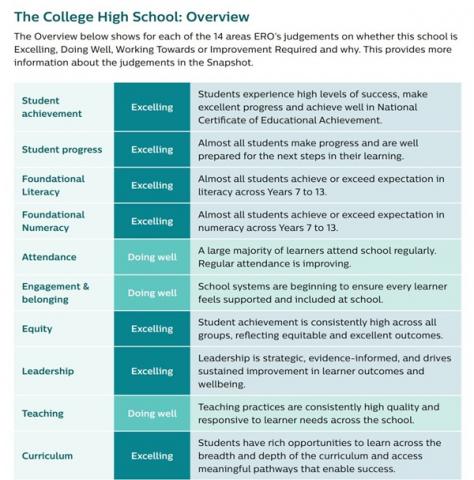
- We have responded to requests from parents and whānau to make school reports easier to understand by including an easy-to-understand Snapshot and an Overview showing judgements for each area.
Clearer language
- We have removed jargon and words that could be confusing.
- We focused on making reports easy for parents and whānau to understand - including changing the wording of areas and judgements to make it clearer.
- We used to describe our judgements for different areas - now we use a clear four-point scale as well as a description.
Clearer about next steps
- Next steps give more detailed actions for school leaders and boards.
- We now include expected timeframes for when those actions should be completed.
- We clearly state if there are recommendations of action required from the Ministry of Education, eg. support for schools.
We have published some examples of our new school reports on our website, so you can explore the new format: Reporting | Education Review Office.
Here is an example of the overview section:
What’s next?
Our evaluators will begin to use the new reports with schools from Term 2.
We are developing a guide for parents and whānau, to explain what matters most about a school, and the practical actions parents and whānau can take to choose and support their child’s school. This is coming in Term 2.
If you have any questions about our new school reports, please email [email protected] or talk with your ERO Evaluation Partner or Toki ao Mārama.
How ERO works with schools: Te Ara Huarau
We are committed to driving continuous improvement in school and kura performance, to support improved outcomes for all learners.
We introduced our new approach to school reviews, Te Ara Huarau, in 2020. We have had a positive response from schools about the collaborative nature of Te Ara Huarau, and how, by working alongside you, we can effectively identify areas for improvement and lift learner outcomes.
Feedback from schools has helped us to make some small adjustments to Te Ara Huarau, to ensure our school reviews and evaluations are consistent, efficient, and bring about school improvement.
You will notice some changes:
- Our evaluators may work in pairs or in small teams during a review for larger schools. This means when we undertake onsite review and evaluation activities, you may meet with two or more ERO evaluators.
- We may also have additional evaluators to join parts of the review online if required.
- We have centralised the way we schedule reviews, so you will receive more notice of an upcoming visit. This also gives you more time to gather the documentation for the review.
- We are scheduling regular progress engagements with schools that require more support – these monitoring engagements can be online or onsite.
The three phases of Te Ara Huarau
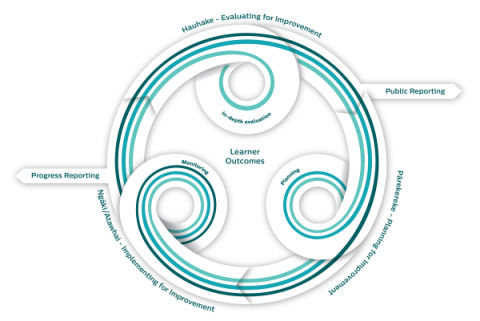
Hauhake | Evaluating for Improvement: every school has a Hauhake review every 3-4 years. ERO undertakes onsite visits during Hauhake. An ERO school report is written and published after this phase.
Pārekereke | Planning for Improvement: schools use ERO’s findings from the Hauhake phase and integrate the recommended next steps for improvement into their school plan.
Ngaki / Atawhai | Implementing for Improvement: if a school needs a higher level of support to bring about the necessary improvements to lift learner outcomes, ERO will regularly monitor the school’s progress and recommend further support if necessary.
There’s more detail on our website
You can also go to our website for an overview of Te Ara Huarau, detailing the steps for the Hauhake phase of the school review process.
Your feedback
We are always keen to hear your feedback on our review approach, and how effective the review was for your school. To help us to improve, please fill out the Post Review Questionnaire, which is sent to you when you receive your confirmed report.
We will be hosting some webinars to walk you through Te Ara Huarau, so you can be confident going into your next review.
Keep an eye out for more information about upcoming webinars in your inbox!
Checking in as you implement change
We know that for many schools, you will be adjusting and adapting to the recent changes. We understand that it will take time for everything to settle. During a review, we'll be checking in with you to see how you are doing, and what plans you have in place as you implement these changes.
Attendance Management Plans
- As part of our Board Assurance Statement, the board attests to the school having an Attendance Management Plan, which sets out a strategy and process for the school to identify and respond to student absences.
- The board attests that the school's plan complies with the regulations.
- We will ask you about attendance, how you identify and respond to attendance barriers and underlying causes of absences, how you monitor and measure progress in attendance, including any targets set by the board or the government. We will need to see your Attendance Management Plan.
Reporting requirements, assessment and aromatawai
- As part of our Board Assurance Statement, the board attests to reporting on progress and achievement of students.
- The board attests that the school is using good quality assessment or aromatawai information to report to each student and their parents.
- We will ask you how your reporting provides parents with timely and meaningful information about the progress their child is making in line with the curriculum, their areas of strength, improvement and next steps. We will also ask about your assessment information, and how you determine how each student is progressing with their learning.
How you are supporting Māori learner success
- We are focused on equity and excellence for all learners. During a school review, we will discuss how you are supporting Māori learners’ progress and achievement, setting high expectations and building strong, respectful relationships.
- We expect to see curriculum and teaching strategies that are inclusive and meet the needs of your learners.
Changes to curriculum
- As part of our Board Assurance Statement, the board attests to the school meeting the curriculum requirements.
- We are interested to see that all learners have rich opportunities to learn across the breadth and depth of the New Zealand Curriculum / Te Marautanga o Aotearoa.
We want to know how your curriculum builds from learners’ experiences, knowledge and understanding, and that your school offers a range of relevant and meaningful learning opportunities.
Progress engagements
We all want every school to be a great school, where learners reach their full potential. We recognise that some schools need more support to bring about the improvements required to lift learner success.
During the school review process, our evaluators may identify that a school needs additional support or intervention. Commonly, these are schools that aren't making good progress for their students overtime, for example: low regular attendance and a high number of students who are chronically absent, low progress and achievement, and, in secondary schools, a significant number of students leaving school without NCEA qualifications. Additionally, these schools need support to shift the underlying conditions within the School Improvement Framework that drive improvements to student outcomes.
Where we identify that a school needs additional help, we work closely with the Ministry of Education to ensure that the right support is provided in a timely way. To make sure that this support is making a difference, we will monitor the school’s progress against the improvement actions outlined in the school’s report with a programme of regular check-ins and visits.
When a school has an online check in, we will write a summary of progress made and will share this with the school. When a school has an in-person progress visit, we will produce a progress report. This provides information about the progress the school is making towards the improvement actions identified in the school’s most recent ERO evaluation.
We have begun to notify schools of upcoming online and in-person progress engagements by email. Our progress engagements will generally take place in the last three weeks of each term. Some schools will have progress engagements scheduled for each term, and some schools will have progress engagements twice a year.
This approach means we are ensuring our monitoring (the Ngaki/Atawhai phase of our review process) is with schools that need the most help to bring about improvement.
ERO's evaluation toolkit
We have a range of tools and resources for you to use for your own internal evaluation.
Each resource is designed to support you throughout your improvement journey, providing practical guidance, evidence-based frameworks, focusing on areas that improve outcomes for learners.
We use these tools with you as part of a school evaluation.
School Improvement Framework (SIF)
The School Improvement Framework (SIF) is an internal evaluation tool to help you to identify where you are on an improvement journey, identify next improvement steps, and monitor progress. The SIF focuses on the areas that have the greatest impact on learner outcomes; school leadership, teaching and learning, and curriculum, and aligns to ERO’s School Evaluation Indicators. Te Tititi o Waitangi is the foundation for success and is woven throughout each domain of the SIF.
Teaching Observation Framework (TOF)
The Teaching Observation Framework (TOF) supports you to identify effective teaching practices in your school and make improvements where necessary. The TOF describes what effective teaching practice looks like at a classroom level and will guide you to make a judgement about where your school sits in the Teaching and Learning domain of the School Improvement Framework (SIF).
Poutama Reo
Poutama Reo is an easy-to-use tool that helps you understand your school’s provision of te reo Māori and clarify the next steps you can take to drive improvement. As you work through the framework, you will develop a te reo Māori improvement plan for your school. Poutama Reo provides examples of effective practice, giving you clarity and support to enable you to achieve your te reo Māori goals.
Raupapa Ako Framework
The newest tool in our kit is the Raupapa Ako Framework (RAF) for high-quality Māori-medium immersion education in English-medium settings.
Schools with rumaki / reo rua will use the RAF as an internal evaluation tool when considering outcomes for ākonga. ERO’s Toki ao Mārama / Te Reo Māori Advisors use the completed framework to guide their work with the rumaki/reo rua to support your approaches to excellence for ākonga Māori.
The RAF aligns with our School Improvement Framework, ensuring that a consistent and considered approach to improvement is taken across an entire school for learners and their whānau. The RAF is already being used in the majority of schools with a rumaki, alongside the SIF, and will be available on our website soon.
‘Afa Framework
The ‘Afa Framework: Pacific Bilingual and Immersion Education Indicators supports school leaders and teachers in designing and evaluating programmes in Pacific Bilingual and Immersion Education contexts. The 'Afa Framework complements the School Improvement Framework and reflects the teaching practices in our Teaching Observation Framework, which is underpinned by Tapasā: Cultural Competencies Framework for Teachers of Pacific Learners.
Board Assurance Statement and Self-Audit Checklists (BAS)
The Board Assurance Statement (BAS) and Self-Audit Checklists help your school board check that they meet regulatory and legislative requirements. The BAS has been refined and shortened to be more sharply focused on what matters most for learners, including health, safety and wellbeing, attendance, progress, and achievement.
ERO's research and insights: practical good practice guides and resources for schools
Did you know ERO has a dedicated evidence website?
Go to evidence.ero.govt.nz for all of our research reports, practical guides, and other useful resources.